Frequently Asked Questions
The most-asked questions about chemical bonding and structure.
What exactly is chemical bonding and structure?
It is the branch of chemistry that explains how and why atoms link into molecules, crystals, and extended solids, and what three-dimensional shapes those arrangements adopt. Think of it as the relationship drama of the atomic world, governed by electron distribution and energy minimization.
Who are the central figures in the field?
Gilbert N. Lewis introduced the electron-pair bonding model in 1916, Linus Pauling unified quantum mechanics with chemical intuition in his 1939 textbook, and Robert Mulliken developed molecular-orbital theory. Roald Hoffmann's frontier-orbital approach and Klaus Müllen's work on conjugated macrocycles represent more recent milestones.
Where should a complete beginner start?
Begin with the octet rule and Lewis dot structures to build a visual sense of how atoms transfer or share electrons, then move into VSEPR geometry and basic molecular-orbital diagrams. A general-chemistry bonding chapter paired with a 3D molecular model kit gives the fastest intuitive grounding.
What are the main bond types and how do they differ?
Ionic bonds arise from full electron transfer and the resulting electrostatic attraction; covalent bonds involve shared electron pairs localized between two atoms; metallic bonds delocalize electrons across an entire lattice. In practice most real bonds sit somewhere on a continuum between these idealized categories.
What is the most pivotal 'reveal' in bonding theory?
The 1927 Heitler-London treatment of the hydrogen molecule provided the first quantum-mechanical derivation of a covalent bond, showing that electron sharing genuinely lowers the system's energy. It shifted bonding from an empirical valence picture to a wave-mechanical one and launched modern quantum chemistry.
What is the octet rule and why is it so central?
It is the heuristic that main-group atoms tend to surround themselves with eight valence electrons, mimicking a noble-gas configuration. It works remarkably well for second-row elements like carbon and oxygen but breaks down for odd-electron species, transition metals, and expanded-shell compounds.
How does VSEPR fit into the bigger picture?
VSEPR predicts molecular geometry by assuming electron pairs around a central atom repel one another and spread as far apart as possible. It is the fastest mental shortcut for predicting shapes—bent, trigonal planar, tetrahedral—without running a single quantum calculation.
What is the difference between valence-bond and molecular-orbital descriptions?
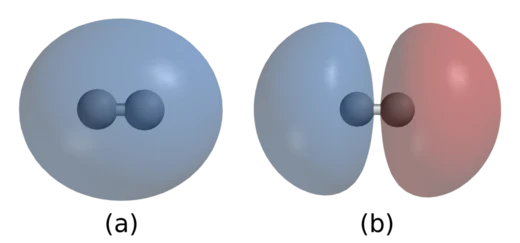
Valence-bond theory localizes electrons in bonds between specific atom pairs and leans on hybridization, while molecular-orbital theory distributes electrons over the whole molecule in delocalized orbitals. The two agree for simple diatomics but diverge sharply for delocalized systems like benzene, where MO theory captures resonance naturally.
Why do transition-metal complexes behave so differently from main-group molecules?
d-orbitals introduce multiple closely spaced energy levels, crystal-field splitting, and variable oxidation states that have no analogue in pure s/p bonding. This is why a single metal center can adopt geometries and spin states that carbon chemistry never encounters.
What is a common misconception newcomers should unlearn early?
The biggest one is treating bonds as rigid little sticks with fixed lengths; in reality they vibrate, bend, and stretch, and their 'strength' is an average over a distribution of geometries. Also, 'sharing' electrons does not mean each atom gets a half-electron—it means electron density is redistributed to lower the total energy of the system.